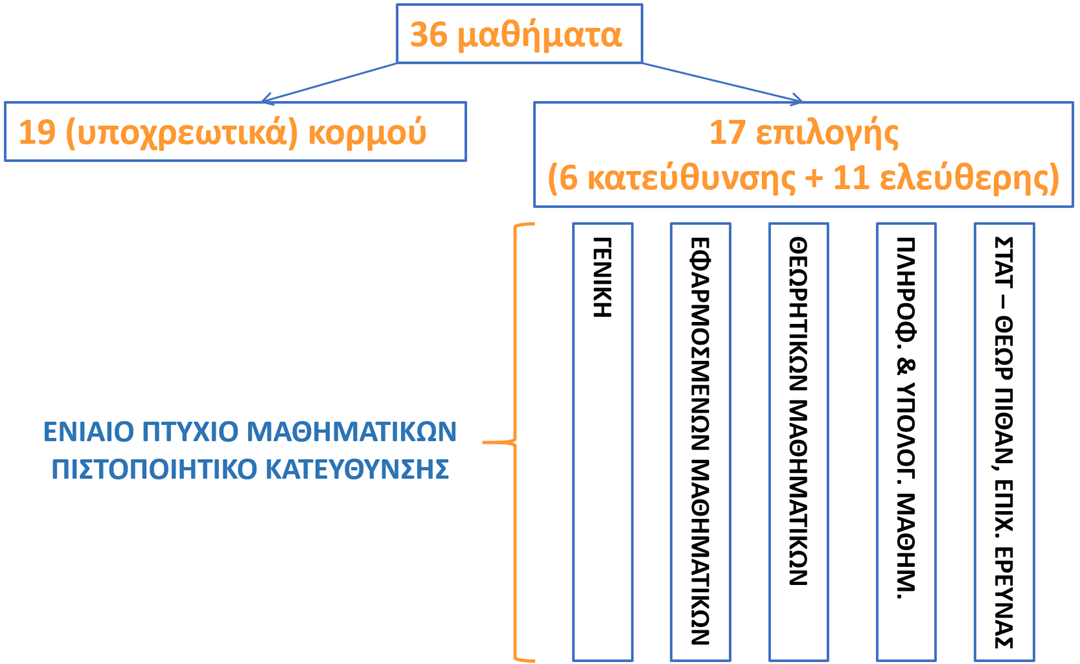
Το Πρόγραμμα Προπτυχιακών Σπουδών του Τμήματος Μαθηματικών συνίσταται από ένα σύνολο μαθημάτων κατανεμημένων σε οκτώ εξάμηνα σπουδών με τρόπο ώστε να ικανοποιούνται η χρονική αλληλουχία και η αλληλοεξάρτησή τους. Διαρθρώνεται σε τρεις συστατικές ενότητες:
- Η πρώτη περιλαμβάνει Μαθήματα Υποχρεωτικά για όλους τους φοιτητές (κορμός). Πρόκειται για 19 μαθήματα τα οποία προσφέρουν αφενός τα βασικά μεθοδολογικά εργαλεία γνώσεων - αναφοράς της επιστήμης, και, αφετέρου, μια εισαγωγή σε επιμέρους γνωστικά αντικείμενα. Διδάσκονται κατά το 1ο, 2ο, 3ο, 4ο, 5ο και 6ο εξάμηνο σπουδών.
- Η δεύτερη ενότητα είναι το Πρόγραμμα Κατεύθυνσης. Με την έναρξη του 4ου εξαμήνου φοίτησης, οι φοιτητές επιλέγουν την Κατεύθυνση Σπουδών που θα ακολουθήσουν. Ως "κατευθύνσεις" νοούνται ομάδες μαθημάτων τα οποία παρουσιάζουν επιστημονική συνάφεια και προσανατολίζουν τον απόφοιτο του τμήματος Μαθηματικών προς μία από τις πολυποίκιλες πτυχές - εφαρμογές της μαθηματικής επιστήμης. Σε κάθε κατεύθυνση υπάρχουν 6 συγκεκριμένα μαθήματα που υποχρεούνται να επιλέξουν οι φοιτητές. Αν και ο χορηγούμενος τίτλος σπουδών είναι ενιαίος, αυτός του Μαθηματικού, σε κάθε απόφοιτο χορηγείται βεβαίωση στην οποία προσδιορίζεται η κατεύθυνση των σπουδών του. Το Τμήμα Μαθηματικών του Πανεπιστημίου Πατρών υποστηρίζει τις παρακάτω πέντε Κατευθύνσεις Σπουδών Εξειδίκευσης:
- ΓΕΝΙΚΗ κατεύθυνση
- Κατεύθυνση ΕΦΑΡΜΟΣΜΕΝΑ ΜΑΘΗΜΑΤΙΚΑ,
- Κατεύθυνση ΘΕΩΡΗΤΙΚΑ ΜΑΘΗΜΑΤΙΚΑ,
- Κατεύθυνση ΠΛΗΡΟΦΟΡΙΚΗΣ & ΥΠΟΛΟΓΙΣΤΙΚΑ ΜΑΘΗΜΑΤΙΚΑ,
- Κατεύθυνση ΣΤΑΤΙΣΤΙΚΗ - ΘΕΩΡΙΑ ΠΙΘΑΝΟΤΗΤΩΝ, ΕΠΙΧΕΙΡΗΣΙΑΚΗ ΕΡΕΥΝΑ.
- Τέλος, υπάρχει η ενότητα των Μαθημάτων Ελεύθερης Επιλογής, μαθήματα με τα οποία προσφέρεται η δυνατότητα επέκτασης των γνώσεων των αποφοίτων μας σε θέματα γενικότερης παιδείας, ξένων γλωσσών, απόκτησης δεξιοτήτων από άλλα τμήματα του Πανεπιστημίου Πατρών, εμβάθυνσης σε διεπιστημονικά θέματα, κ.λπ. Με την επιλογή 11 εξ αυτών, οι φοιτητές ολοκληρώνουν τις σπουδές τους. Σημειώνεται πάντως ότι, δεν προσφέρονται κάθε ακαδημαϊκό έτος τα ίδια μαθήματα Ελεύθερης Επιλογής.
Εκτός των ανωτέρω κατηγοριών μαθημάτων, στο τμήμα, ως προαιρετική επιλογή των φοιτητών, προσφέρεται η δυνατότητα πρακτικής άσκησης (δείτε εδώ τον κανονισμό) αλλά και εκπόνησης διπλωματικής εργασίας (δείτε εδώ τον κανονισμό).
Πιστωτικές Μονάδες (ECTS)
Κάθε μάθημα του προγράμματος σπουδών του Τμήματος αντιστοιχεί σε έναν αριθμό διδακτικών μονάδων (ΔΜ). Οι ΔΜ χρησιμοποιούνται αποκλειστικά για τον υπολογισμό του βαθμού πτυχίου. Παράλληλα, κάθε μάθημα χαρακτηρίζεται, επιπλέον από τις διδακτικές, και από έναν αριθμό πιστωτικών μονάδων (ECTS). Τα Ανώτατα Εκπαιδευτικά Ιδρύματα (ΑΕΙ) οργανώνουν τα προγράμματα σπουδών τους με βάση το ευρωπαϊκό σύστημα μεταφοράς και συσσώρευσης πιστωτικών μονάδων, ώστε τα προγράμματα σπουδών τους να μπορούν να περιγραφούν με ενιαίο τρόπο και να είναι δυνατή η μεταφορά και συσσώρευση επιτυχών επιδόσεων σε άλλα προγράμματα σπουδών του ιδίου ή άλλου ΑΕΙ, σε εθνικό και ευρωπαϊκό επίπεδο. Οι πιστωτικές μονάδες εκφράζουν το φόρτο εργασίας που απαιτείται για την ολοκλήρωση μιας μαθησιακής δραστηριότητας, όπως είναι η παρακολούθηση παραδόσεων, τα σεμινάρια, οι εργασίες, η πρακτική άσκηση, η μελέτη και οι εξετάσεις και αποδίδονται σε κάθε μάθημα και στην πρακτική άσκηση και διπλωματική εργασία. Κάθε ακαδημαϊκο εξάμηνο περιλαμβάνει εκπαιδευτικές δραστηριότητες που αντιστοιχουν σε 30 μονάδες ECTS (με το φόρτο εργασίας που απαιτείται να καταβάλει κάθε φοιτητής κατά τη διάρκεια του έτους να εκτιμάται κατά μέσο όρο στις 1500-1800 ώρες εργασίας, δηλαδή 1 μονάδα ECTS αντιστοιχεί σε 25 έως 30 ώρες "εργασίας"). Οι πιστωτικές μονάδες απονέμονται στους φοιτητές μετά την ολοκλήρωση των μαθησιακών δραστηριοτήτων τους και συσσωρεύονται με σκοπό την απόκτηση του πτυχίου: ο προπτυχιακός κύκλος σπουδών στο Τμήμα Μαθηματικών του Πανεπιστημίου Πατρών συνίσταται στην επιτυχή παρακολούθηση Προγράμματος Προπτυχιακών Σπουδών, το οποίο περιλαμβάνει μαθήματα που αντιστοιχούν σε 240 μονάδες ECTS (30 ECTS σε καθένα από τα 8 εξάμηνα σπουδών). Η μεταφορά και η συσσώρευση πιστωτικών μονάδων διευκολύνονται με τη χρήση των εγγράφων του ECTS, δηλαδή, κυρίως, με το Παράρτημα Διπλώματος (το οποίο εκδίδεται στην Ελληνική και Αγγλική γλώσσα).
Μαθησιακοί Στόχοι
Το Τμήμα επιδιώκει οι πτυχιούχοι του να είναι υψηλής ποιότητας και με κατάρτιση που να τους καθιστά ολοκληρωμένους επιστήμονες οι οποίοι θα έχουν τη δυνατότητα όχι μόνο να επεξεργάζονται και να χρησιμοποιούν τις γνώσεις που έχουν αποκτήσει, αλλά και να αναγνωρίζουν την εφαρμοσιμότητά τους. Πρωταρχικός στόχος του Τμήματος είναι η προαγωγή, μέσω της επιστημονικής έρευνας και παιδαγωγικής διαδικασίας, των μαθηματικών, προκειμένου οι απόφοιτοί του να έχουν μια συνολική-σφαιρική εικόνα τους, καθώς, και εκείνα τα εφόδια με τα οποία καθίσταται σαφές το πρακτικό ενδιαφέρον των μαθηματικών στις φυσικές, τεχνολογικές, οικονομικές και κοινωνικές επιστήμες. Προσφέρονται μαθήματα υποδομής, τα οποία καλύπτουν ένα ευρύ φάσμα γνώσεων της μαθηματικής επιστήμης, αλλά και εξειδικευμένα μαθήματα Θεωρητικών Μαθηματικών, Εφαρμοσμένων Μαθηματικών, Πληροφορικής, Στατιστικής, Διδακτικής, Φυσικής και Οικονομικών που επιτρέπουν στους πτυχιούχους να είναι εξοικειωμένοι με τις σύγχρονες διαστάσεις της μαθηματικής επιστήμης.
Απονομή Πτυχίου
Η διάρκεια των σπουδών για την απόκτηση του ΠΤΥΧΙΟΥ ΜΑΘΗΜΑΤΙΚΩΝ είναι τετραετής. Ο φοιτητής ολοκληρώνει τις σπουδές του και αποκτά ΠΤΥΧΙΟ ΜΑΘΗΜΑΤΙΚΩΝ όταν έχει συγκεντρώσει (τουλάχιστον) 240 μονάδες ECTS μέσα στο χρονικό πλαίσιο της φοίτησής του, κατά τη διάρκεια του οποίου εγγράφηκε, παρακολούθησε και εξετάστηκε επιτυχώς σε τριάντα έξι (36) μαθήματα ως ακολούθως:
- Δεκαεννέα (19) μαθήματα κορμού, τα οποία αθροιστικά συνεισφέρουν 138 μονάδες ECTS.
- Δεκαεπτά (17) μαθήματα επιλογής, τα οποία αθροιστικά συνεισφέρουν 102 μονάδες ECTS, με την βοήθεια των οποίων ο φοιτητής πρέπει να κατοχυρώνει τουλάχιστον μία (1) εκ των πέντε (5) υποχρεωτικών κατευθύνσεων του Τμήματος.
Tο πτυχίο πιστοποιεί την επιτυχή περάτωση των σπουδών και αναγράφει βαθμό ο οποίος υπολογίστηκε στη δεκάβαθμη κλίμακα με ακρίβεια δύο (2) δεκαδικών ψηφίων. Ο βαθμός αυτός κλιμακώνεται σε: καλώς από πέντε (5) ως και έξι και σαράντα εννέα (6.49), λίαν καλώς από έξι και πενήντα (6,50) ως και οκτώ και σαράντα εννέα (8,49) και άριστα από οκτώ και πενήντα (8,50) ως και δέκα (10). Το πτυχίο εκδίδεται από το τμήμα σύμφωνα με τον γενικό τύπο πτυχίου του Πανεπιστημίου Πατρών. Η ημερομηνία κτήσης του πτυχίου είναι κοινή για όλους τους φοιτητές που παίρνουν πτυχίο στο τέλος της ίδιας της εξεταστικής περιόδου και είναι αυτή της οριστικοποίησης από τη Γραμματεία των βαθμολογίων για όλα τα μαθήματα.